Janis Ian’s social ostracism
Mean GirlsJanis Ian’s social ostracism is the lasting consequence of Regina George converting a private disagreement between former friends into a public label. Regina’s account links Janis’s exclusion to jealousy over a boyfriend, but the account also reveals a stark imbalance in power: Regina controls the story, while Janis bears the consequences of being named and rejected. The episode becomes the buried origin of their rivalry and a measure of how labels can turn social authority into isolation.
Friendship Recast as Stigma
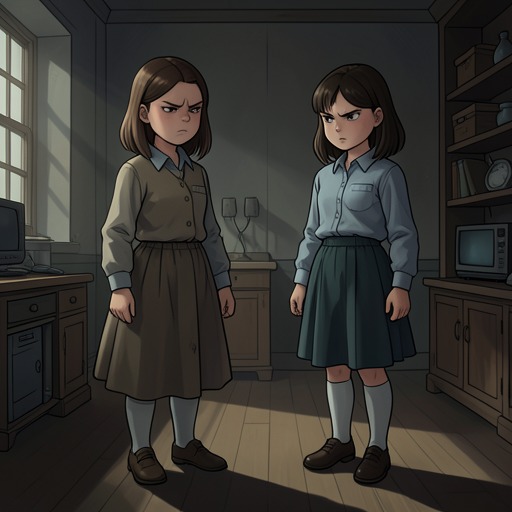
Regina tells Cady Heron that she and Janis were best friends in middle school. In eighth grade, Regina began dating her first boyfriend, Kyle, who later moved to Indiana. Regina says Janis became jealous when Regina spent time with him rather than her. Instead of treating that change as a conflict between friends, Regina framed Janis’s complaints as evidence of an identity she assigned to her. For Regina’s all-girls birthday pool party, she says she told Janis she could not invite her because she thought Janis was a lesbian.
The exclusion was not simply a friendship cooling into distance. Regina’s explanation shows her using a sexual-orientation rumor to make Janis’s absence seem justified to others. Cady recognizes that this is where the rumor began: Janis had objected to Regina taking her friendship for granted after starting a relationship. The difference between the initiating grievance and the label placed on Janis exposes the social force of Regina’s version of events. Her interpretation, not Janis’s own account, becomes the explanation that circulates.
Isolation and Its Aftermath
Regina recalls that Janis’s mother called Regina’s mother to complain. Regina then says that no one would talk to Janis and that Janis had to be pulled out of school for a while. The sequence makes the costs of the rumor concrete: it moved beyond the party and friendship into broad peer rejection and temporary absence from school. Regina’s casual account treats these consequences as part of the story she is telling about Janis, while Cady is stunned as the fragments of Janis’s history begin to fit together.
The evidence gives Regina’s recollection rather than a separate account from Janis, so the details of the intervening period remain filtered through the person who initiated the exclusion. That limitation matters: Regina presents the stigma as a consequence of Janis’s supposed jealousy and oddness, while Cady sees the harm in the original act of exclusion itself. Janis’s later anger is thus grounded not in an unexplained dislike but in a history that Cady learns gradually, and that Regina recounts without recognizing how damaging it sounds.
Humiliation Repeated
Janis’s ostracism returns in the story of Halloween. Regina proposes that the group dress as goddesses, with Regina as Aphrodite and Janis as Artemis. Janis accepts the plan and makes a costume, but the others arrive at school in their ordinary party clothes. Janis alone appears in a toga, carrying a bow and arrow; students point and laugh, and some throw wet toilet-paper wads at her. Regina then reports Janis to the principal as a threat, and Janis receives an in-school suspension while her parents worry about her.
This incident repeats the earlier pattern in a sharper form. Regina first induces Janis to trust a group plan, then leaves her visibly isolated, and finally uses the resulting appearance to bring institutional discipline into the humiliation. Janis later identifies the experience as part of why she is ready to take Regina down. Her resolve is presented as a response to accumulated injury, not merely a sudden contest for popularity.
The Burn Book Makes the Label Public Again
When the Burn Book pages are scattered through the school, Janis sees her own entry: “Janis Ian: dyke.” Damian reacts with outrage, and the label that had once been used to exclude Janis from a private party is now exposed as written abuse circulating through the school. The public appearance of the page gives the old stigma a new audience and places Janis’s experience within a wider crisis of insults and accusations.
The recurrence links the private origin of Janis’s exclusion to the school-wide consequences of the Burn Book. Regina’s earlier story shows a rumor becoming a reason to shut Janis out; the later page shows the same kind of labeling preserved, reproduced, and encountered in public. Janis’s ostracism is therefore both a specific history within her former friendship with Regina and an instance of the book’s broader mechanism: a person is reduced to a degrading label, and that label is allowed to stand in for the person.
Conflict, Belonging, and Reversal
The cafeteria scenes place Janis’s history against the everyday organization of North Shore High. On Cady’s first day, the tables appear to be territories occupied by established groups, and an empty seat is claimed to keep her out. When Janis later draws a detailed map of the cafeteria, Cady can name the groups and understand the room as a hierarchy with boundaries. The map offers Cady access to a social landscape that had first made her feel unwelcome; Janis, by contrast, is already known through a history of being singled out and excluded.
Regina’s power also shapes what inclusion feels like for other people. Gretchen Wieners insists that the Plastics have to keep trying to maintain high-school social order, and later Cady feels famous and invincible after Regina gives her a makeover and she walks the hall with the group. Those scenes sharpen the contrast with Janis’s experience: belonging can appear glamorous when Regina grants it, but it remains controlled by the same authority that once turned Janis into an outsider. The story’s social world makes recognition conditional, while the ostracized person has little power over the description that follows her.
Janis’s exclusion does not define the entirety of her later life. At the Jingle Bell Rock performance, Cady sees her parents in the audience and feels that she has become part of ordinary high-school life; the moment marks a different experience of belonging for Cady, not a stated resolution of Janis’s history. Later, at the Mathletes state championship, Cady receives a blue varsity jacket with yellow sleeves and a medal, and Kevin calls her “Africa.” These moments show that social identity can shift across groups and settings, but the evidence does not say that Janis’s past ostracism is simply erased. Its continuing force is visible in the old label’s return and in the personal conflict it helps explain.